The THX Deep Note
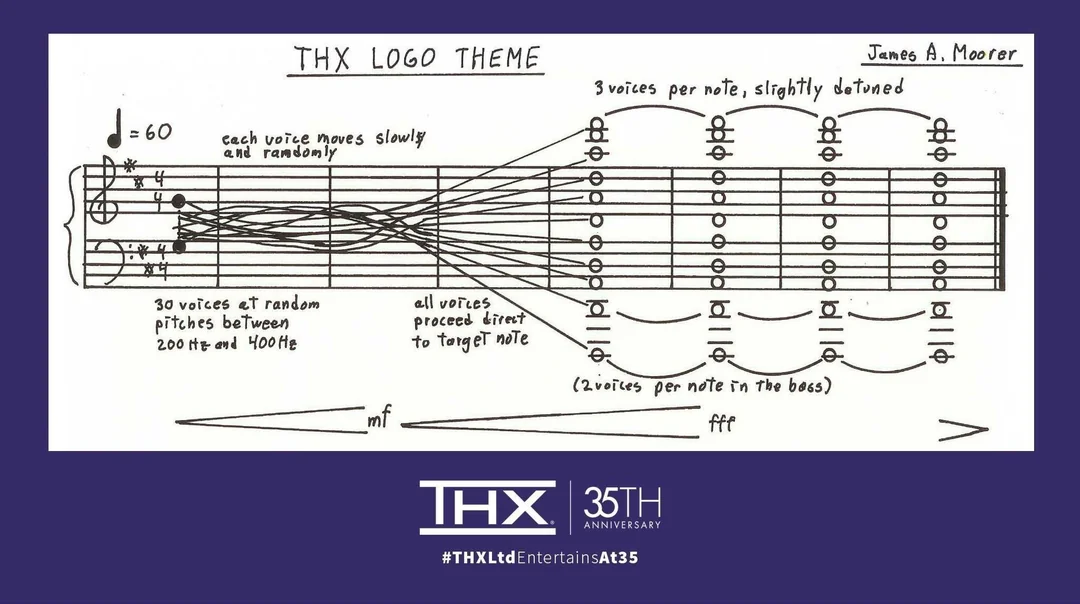
A recreation of the iconic THX “Deep Note” — the synthesized crescendo created by Dr. James A. “Andy” Moorer. Here is the story of the original, the short Python program I wrote to recreate it, the audio it produces, and plots of the resulting output.
The original
The Deep Note is the sound trademark of THX. It was created in late 1982 by Dr. James A. “Andy” Moorer while he was at Lucasfilm’s Computer Division (the group that later became Pixar), and it debuted in 1983 in the THX trailer before the premiere of Return of the Jedi.
The brief was open-ended: Moorer was asked for a sound that “comes out of nowhere and gets really, really big.” Asked to imagine the sound, he first thought of Bach’s famous Toccata and Fugue in D minor for organ, with its opening that resolves into a huge D-major chord — and that became his inspiration for the Deep Note. He built it on Lucasfilm’s Audio Signal Processor — a one-off digital audio workstation — using a compact program of roughly 325 lines of C paired with about 300 lines of audio-patching code. Thirty voices begin clustered in a narrow range around 200–400 Hz, then glide outward to a final chord spanning roughly five octaves. The destination chord was hand-programmed, but each voice’s path to it was shaped by random seeds — so no two performances were ever identical. Moorer later admitted he never wrote down the original seed, which made exact recreation famously difficult.
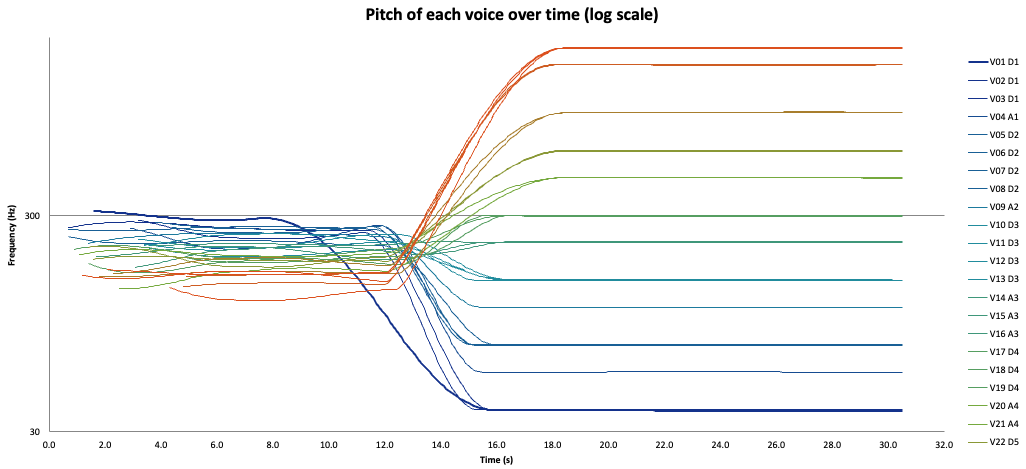
Each of the thirty voices was built by digitizing a cello tone and mapping it through additive synthesis across twelve harmonics. During the opening wander, the highest voices glide down toward the bass while the lowest rise toward the top — the parts effectively crossing over one another on their way to the chord. The final chord was deliberately tuned in just intonation, giving it a purer, more consonant sound than equal temperament.
Moorer’s program moved through three phases: a chaotic “swarm” as the oscillators wobbled around their random pitches, a “linear glissando” as each voice glided along its own trajectory toward a hard-coded destination, and the final just-intonation chord. Even after landing, a microscopic frequency drift kept the voices shifting against one another — a deliberate “shimmer” that keeps the final chord from collapsing into a sterile, static tone.
Named after the computer “Deep Thought” in The Hitchhiker’s Guide to the Galaxy, the Deep Note has become one of the most recognizable audio logos in film history and was registered as a United States trademark in 1992.
At its peak, the sound was reportedly played as often as four thousand times a day. Moorer has called it “the most widely-recognized piece of computer-generated music in the world” — adding, “this may or may not be true, but it sounds cool!” When Dr. Dre sought permission to sample the Deep Note and was refused, he used it anyway, and was sued.
The recreation
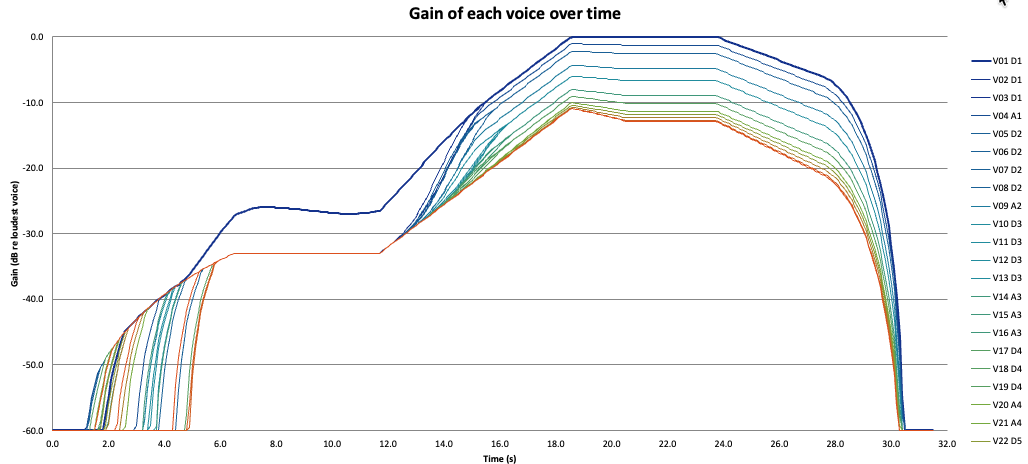
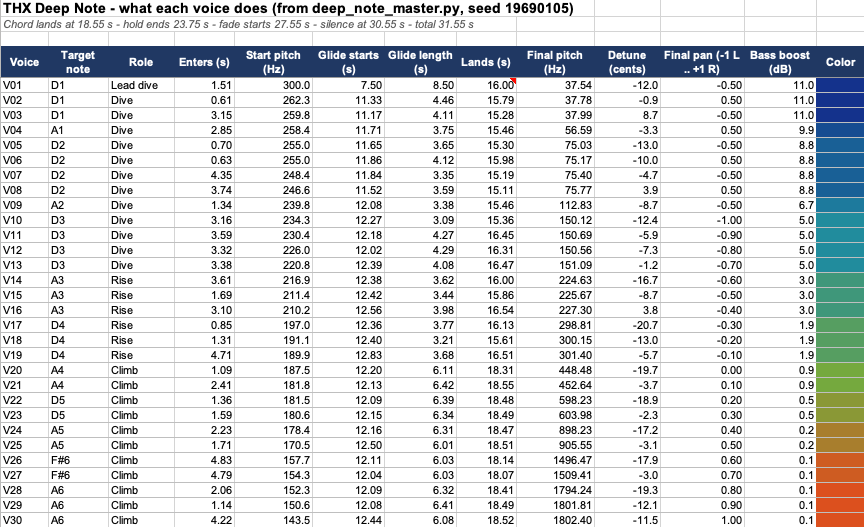
I wrote the program below, which renders the Deep Note from scratch: thirty bright, cello-like voices in four phases — a quiet wander as the voices drift around random pitches, a dive in which they glide together to the final D chord while a crescendo builds, a hold at peak level, and a release that sags and fades to silence. The final chord is a D chord in just intonation (D1, A1, D2, A2, D3, A3, D4, A4, D5, A5, F♯6, A6). A fixed random seed makes every render reproducible.
The program is driven by more than seventy parameters at the top of the file, so the sound can be reshaped without touching the synthesis logic. A few examples: NUM_VOICES sets how many voices are rendered (thirty by default); D1_FREQ tunes the fundamental of the final chord; WANDER_SEMITONES controls how wildly the voices drift during the opening; NUM_HARMONICS sets each voice’s brightness (sixteen here, versus Dr. Moorer’s twelve); DETUNE_BASS and DETUNE_TOP spread the unison voices to produce the beating “shimmer”; PLATEAU_DB sets the quiet level of the opening; and FADE_OUT controls the length of the final fade.
View the source code
Loading source…The audio
The program renders to a 192 kHz stereo WAV. The player below uses a compressed MP3 copy for faster loading; the original WAV is available to download.
Download the original WAV · Download MP3
The data
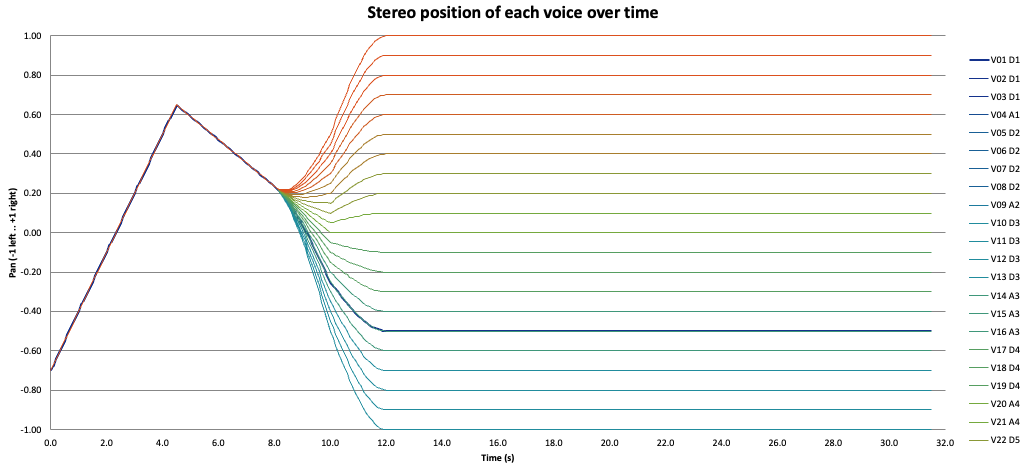
Five plots show what the render is doing: the pitch, gain, and stereo pan of the voices over time, the final output, and the notated final chord.